
What is Mod Podge Dimensional Magic? This acrylic epoxy-like product is great for making jewelry, gifts and more. Learn more about it here!
Scroll down to the bottom of the post to get a video all about this fantastic product. You’ll get to see it in action as well.
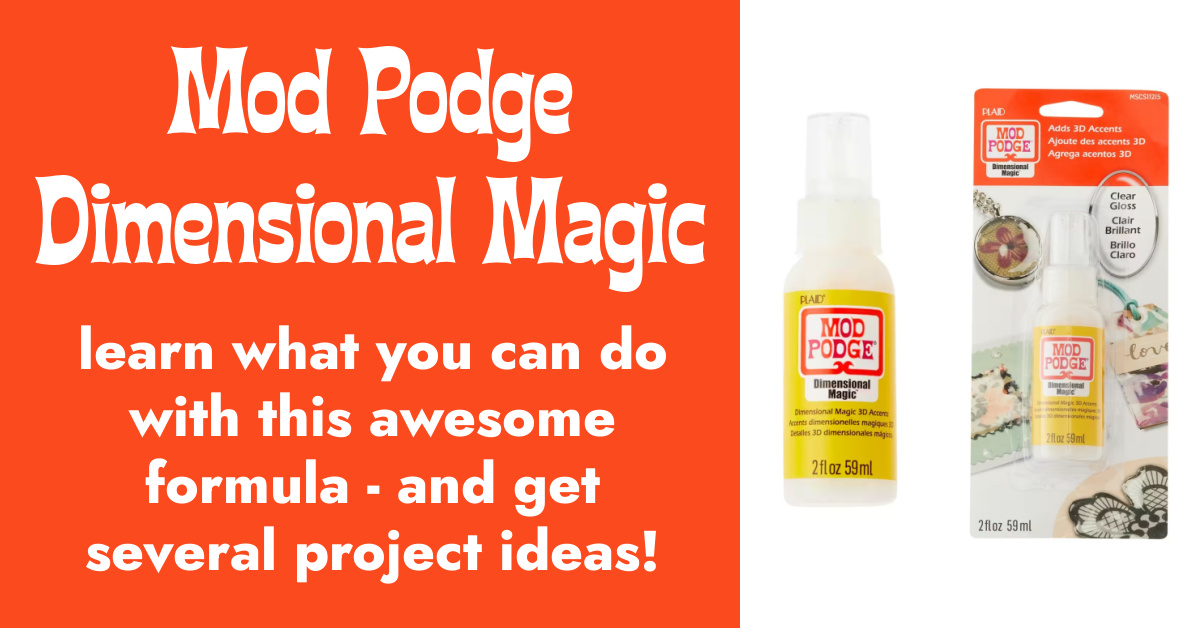
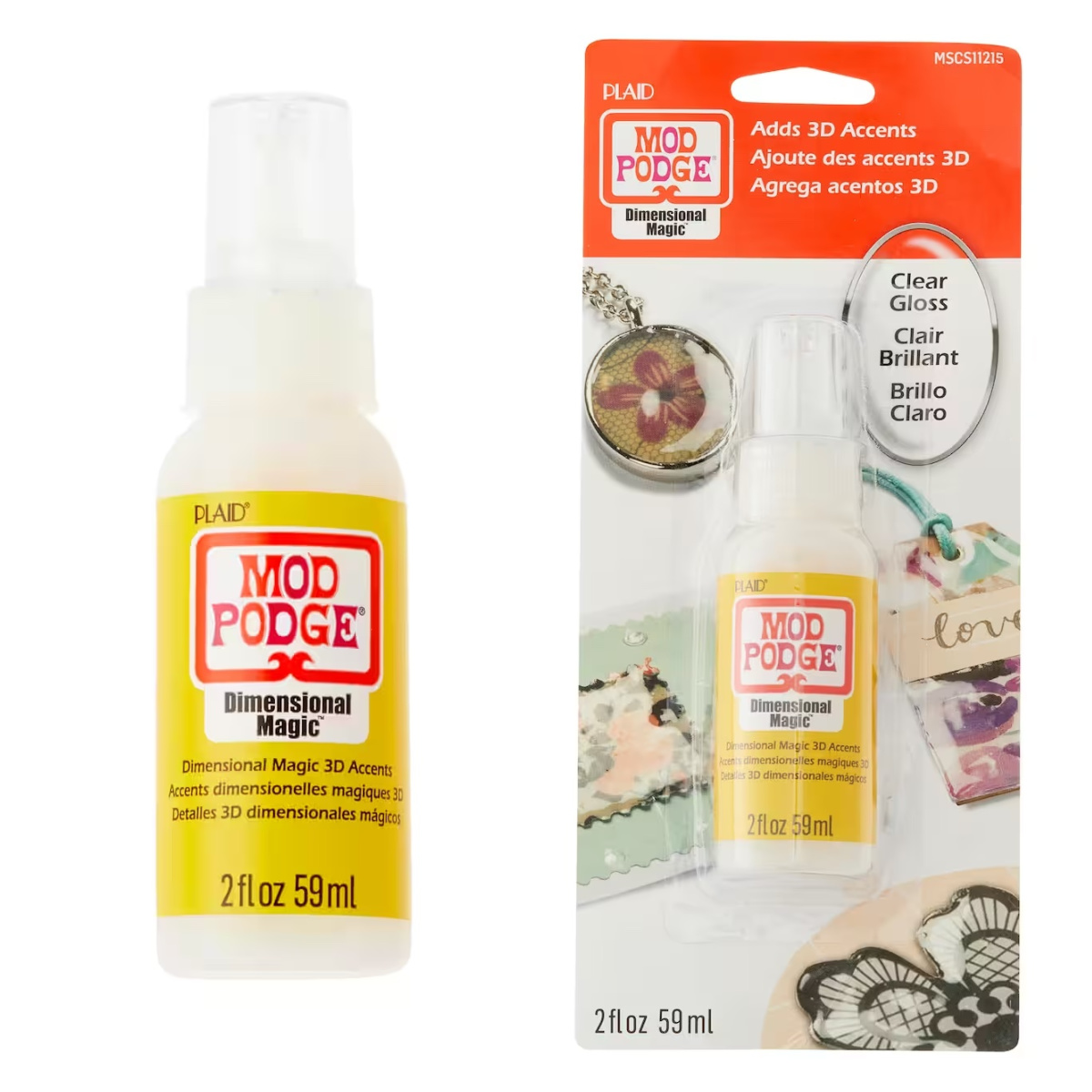
I’ve been getting a lot of questions about this Mod Podge formula, so I thought I would utilize a blog entry to give you all of the information.
Even if you don’t think you need to know about this amazing product, I promise you – you do. Dimensional Magic is just plain wonderful. Like everything Mod Podge.
What is Dimensional Magic?
First of all, it creates an resin-like finish on a project surface. It is not a decoupage medium. So you aren’t using it to do any actual gluing. You’re creating a glassy finish.
Secondly, it’s a waterbased product, and it’s non-toxic. It’s a great way to get a resin look on a much smaller, less-toxic scale.
You can see it in the sample projects or video in this post; it’s glassy and three-dimensional, and it adds interest to the surface of your project. It goes on cloudy but dries completely clear.
What projects do you recommend it for?
Anything really, but it works very well on jewelry, accessories, and cards. Your best bet is to use it to accent small areas. It looks very sharp on bracelets, rings, brooches, belt buckles, necklaces, etc.
I also like it on handmade cards. I’m a big fan of Mod Podging stuff down and then using Dimensional Magic on top of my decoupaged surface.
What surfaces can I use it on?
Just about anything – wood, tin, glass, plastic/acrylic, paper . . . it will dry crystal clear on all of them.

What is the difference between Mod Podge Dimensional Magic and resin?
DM is a waterbase, acrylic product as I said before. This means that you can get it on your fingers and wash it off – and it’s not going to hurt you. You don’t need to wear a mask or gloves to apply it and the fumes aren’t toxic.
There’s also no mixing required – the formula can be applied as-is. Dimensional Magic is used for small projects. You wouldn’t use it to cover a table.
Resin is a “reactive polymer compound” and typically a two part process. For example, Mod Podge Resin. It’s MUCH thicker than Dimensional Magic, and creates a much thicker finish (the box says one coat is equivalent to 50 coats of varnish).
I’m not an expert in reactive polymer compounds, but I can tell you this stuff is toxic. Not that you shouldn’t use it, because you should – but you have to wear gloves and protective equipment when you do. You mix two parts together, apply immediately, and it hardens into a VERY thick coat.
Resin is waterproof, heatproof, and hard to mark. It’s perfectly appropriate for larger projects such as countertops, tables, large trays, etc. For more reading, I wrote an entire guide all about the differences (and when you use each) here.
Do you have any tips for usage?
Why yes! Thank you for asking. Sometimes when Mod Podge Dimensional Magic dries, because it’s waterbase, there’s a dip in the middle. When that happens, just layer it! Yes, you can layer it on top of itself and it dries crystal clear.
Why is my Dimensional Magic cloudy?
Typically it’s because there is moisture below the Dimensional Magic. If you decoupage below your Dimensional Magic, make sure the surface is completely dry for several hours before applying the DM.
If there is moisture below the DM, it can get cloudy when dry.
If your Dimensional Magic gets cloudy, you’ll just have to wait and see if it clears up. If it doesn’t, you’re going to need to re-do the project; there’s no way to fix it. That’s why it’s very important that you let your project dry before application.
Where can I buy Dimensional Magic?
This is probably the question I’ve been asked most often. You can get it online at Amazon, and it’s also sold at most craft stores including Jo-Ann, Hobby Lobby, A.C. Moore and Michaels (find out where to buy Mod Podge here).
I hope this information helps. Complete instructions for usage are on the back of the package, and I’m telling you that it’s just about as easy as Mod Podging. I’m off to DM a fake eyeball! Or something. . .
Before you go, don’t forget to watch the video in this post that tells you everything you need to know about this fantastic project. Simply press “PLAY” in the middle of the video!
Do you want some other guides for Mod Podge? Take a peek at these posts:
Brushstroke • Dishwasher Safe • Extreme Glitter • Fabric • Furniture • Glow in the Dark • Gloss • Hard Coat • Matte • Outdoor • Satin • Sparkle • Super Matte • Photo Transfer Medium • Puzzle Saver • Stiffy • Ultra






Can I layer DM on a metal backed cabachon over tiny gems and little copper nuggets to make a vibrational pendant. Will it dry clear if I do. Does it get affected by environmental situations such as damp weather or cold etc? Can I coat with clear nail hardener varnish to protect it further. X Thanks.
Yes — you can layer Dimensional Magic over metal-backed cabochons. Let dry between layers. If you see dips appear due to drying, you can fill them in. DM can be layered and will still dry clear. DM should be fine in damp weather or cold as long as it’s fully dried. Do NOT put it under a fan while it’s drying or have it drying in a cold place. It can crack. Make sure it dries somewhere warmer or room temp. Once fully cured, you can add a light clear topcoat, but test first since some nail hardeners can soften it. It’s great for decorative jewelry, just not as durable as resin for heavy wear.
All, I have recently started using DM to fill in a shape laser cut from wood. First go round, everything was awesome in the application process. Next day, they DM had absorbed the burned wood residue and turned cloudy brown. Second go round, I sprayed the fille surfaces (laser burned wood) with clear acrylic spray and it turned out nice except bubbles appeared that were not there when I stopped for the day. 3rd go round, everything the same except I used a lighter to apply heat to draw out the bubbles (like regular resin) and it worked! Next morning, the center of the DM fill had a huge empty spot. I think the heat did something to it! So, I have concluded that DM will react to inks, paints, wood resin, and heat. I am going to do one more test with the clear acrylic and no heat. Just have to watch for bubbles a bit longer and makes sure I use the needle on them. I appreciate reading all the experienced user’s comments and suggestions.
Hi there, I had a question about denting. I did a test run of DM a few days ago — just a small amount on some cardstock to see how it worked. It has been 72+ hours and while it appears hard at first glance, it remains easily dentable with a moderate push of a fingernail. I was just wondering if you may have some insight as to whether it sometimes takes even longer than 3 days to fully harden? Or if there are any factors that might have caused it to remain fairly easy to dent? Thanks — your website has been an awesome resource since I’ve gotten into crafting! 🙂
The factors that make it fairy easy to dent is that it’s an acrylic based product. It will always be more “dentable” than resin. The benefit is that it’s non toxic tho. What I can say is that it will still harden over time. Give it about 30 days to fully cure (not dry, which is different). It should be harder than it is after 72 hours. 🙂
That is good to know! Thank you so much for the info. It’s good to know it’s not because I did something wrong haha
This is great for the cardboard tokens in your favorite board games to keep them from getting damaged or broken.
You can apply a small amount to simply keep the tokens protected with a basic coating, or create a rounded top to make your games look custom while ensuring they will be like new even if your game nights get competitive week after week.